What Is a Fractional COO (Virtual COO)? Services, Rates, and What They Do For Your Business
Running a growing service-based business can feel like a lot. You're juggling client demands, managing a never-ending to-do list, trying to keep your team on the same page, and somehow also trying to grow the business behind the scenes.
If you've been Googling "fractional COO" or "virtual COO," you're probably at the point where the business is working, but the way it runs behind the scenes hasn't kept up with the demand in front of it.
Let's talk about what a fractional COO is, what fractional COO services look like, what it costs, and how to figure out if it's the right move for your business.
→ Let’s break it down.
What is a Fractional COO?
A COO (Chief Operating Officer) is the person in a company who owns how everything runs. The systems, the processes, the team coordination, the structure behind the scenes that lets the business grow without the founder holding every single piece together.
A fractional COO does that same work, just scoped to what your business needs right now, on a contract basis instead of a full-time salary. You might also see it called a "virtual COO." Same role, different name.
For small businesses and growing service-based companies, this is a big deal. Someone who can see the full picture of how your business operates, spot where things are breaking down (or about to), and build the systems to support what comes next.
What Do Fractional COO Services Include?
The specifics look different for every business, but here's what fractional COO services typically involve for service-based companies:
Process Mapping and Operational Architecture
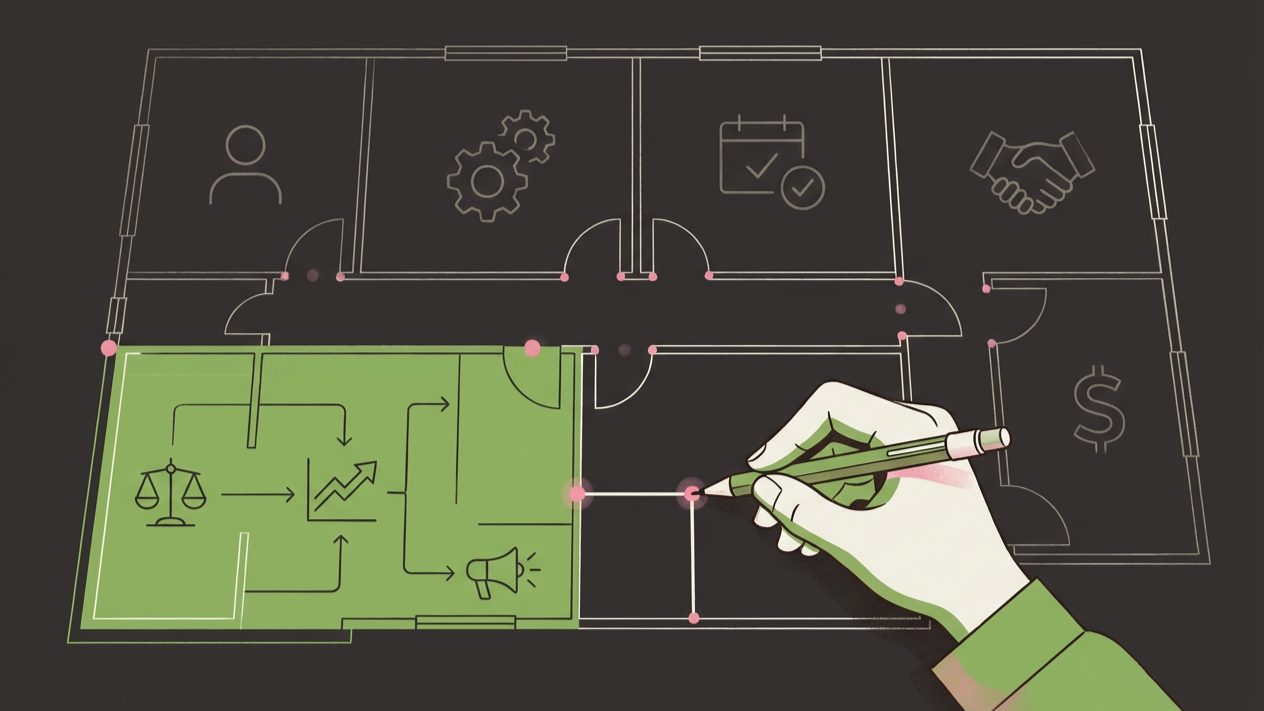
Before anything gets built or fixed, a good fractional COO maps out how your business runs right now, day-to-day. That map gives you both visibility on the details of your business, and becomes the foundation for everything else, because you can't fix what you can't see.
Systems Setup and Cleanup
If you've got a CRM, project management tools, or workflow apps that you set up yourself a while back and they still feel messy (be honest), this is where a fractional COO earns their weight. They configure your tools to match how your business works so things stop falling through the cracks.
Automations That Reduce Manual Work
Client onboarding, follow-up, recurring tasks (oh my!). All the stuff you're doing by hand over and over because you never had time to set up a better way. A fractional COO identifies the highest-impact automations and builds them so your business keeps moving, even when you step away.
SOPs and Documentation
All the stuff that lives in your head? Or in "that one Google Doc somewhere"? A fractional COO turns that into documented, repeatable processes your team can follow without needing you every step of the way. This is what makes delegation and hiring possible down the road.
Team Structure and Coordination
As you bring on contractors or employees, a fractional COO helps create clarity around roles, workflows, and communication. Who's responsible for what, where work lives, how handoffs happen. The kind of structure that keeps a growing team from turning into a stress-inducing mess.
Ongoing Strategic Partnership
Fractional COO consulting isn't just about building systems and walking away. For a lot of businesses, the most valuable part is having someone to think through decisions with on a regular basis!
From hiring plans and capacity questions, to new services and how to handle growth without losing what makes your business special. Having someone who understands your operations deeply enough to be a real strategic partner is incredible valuable!
How Much Does a Fractional COO Cost?
Let's talk about fractional COO rates, because that’s what you really want to know, isn’t it? 😁
As you’d expect, pricing can vary pretty significantly. Depending on the type of engagement, the scope of work, and the consultant's experience, etc. But here are the general ranges you'll see:
Strategy or Audit Engagements
These are typically one-time sessions focused on diagnosing what's going on in your operations and mapping out what needs to change. Pricing generally starts in the low hundreds and can go up to a few thousand dollars depending on how deep the engagement goes.
Project-Based Builds
This is where someone designs and implements your operational backend: systems, automations, SOPs, client workflows. Project-based fractional COO services generally start around $3,000 and can go to $10,000 or higher depending on how complex the business is and how much needs to be built.
Monthly Retainers
For ongoing fractional COO support, monthly retainers generally start around $1,500 to $2,000/month for lighter-touch engagements and can go up to $10,000/month or more for deeply embedded operational leadership. Where you land depends on how many hours are involved, what's included, and how hands-on the relationship is.
Do I Need a Fractional COO?
Here are some of the most common signals. If a few of these sound familiar, maybe we should chat:
Your business has consistent demand and revenue, but the backend feels like it's held together with duct tape.
You've tried setting up systems yourself (or hired someone to do it) and it still isn't working the way you need it to.
Everything depends on you. If you stepped away for a week, things would stall.
You're reactive most of the time. Planning a week ahead at best, putting out fires more often than building ahead.
You want to hire (or you've already hired) but your team doesn't have clear processes to follow.
You're spending more time on admin and coordination than on the work that grows the business.
A fractional COO for small business isn't reserved for companies with big budgets and big teams.
It's for any business where the founder has become the bottleneck and the operations need to catch up to the demand!
Interested in learning more?
Schedule a free consultation with me to help point you in the right direction!
What's the Difference Between a Fractional COO, a VA, and an OBM?
A virtual assistant handles tasks: inbox management, data entry, admin support. They do what you ask them to do.
An online business manager (OBM) manages day-to-day operations. They oversee your clients, keep projects on track, and handle execution.
A fractional COO operates at the strategic level. They're looking at how the entire business runs, designing the systems and processes, and making decisions about operational direction. They're the one building the infrastructure that makes everything else work.
These roles don’t compete with each other. They're different levels of support, and many businesses eventually have all three.
But if the issue is structural, if there's no system or process in place to manage yet, a VA or OBM won't be able to solve that for you.
Want to Talk Through Your Business?
If a lot of this felt familiar, that's actually a good sign. It means you're paying attention to what needs to change!
Let’s have a conversation to talk through where your operations are and what the right next step looks like for your business.
Liked This Article? Pin It For Later!